Face clear and sharp
Upload a clear face-on photo, large and sharp enough to read on both the eater and the dancing clones. Soft, tiny, or cropped-out subjects make identity drift.
Viral template
A short taco-table clone Dougie: your photo keeps that motion. Genjutsu AI holds the timing. Stills change the look.
About 12 seconds
On this page
The panel below is the homepage studio, already on this template. The sample is the taco-table clone Dougie motion reference.
Reference video
Teach Me How to Dougie AI
12s · 920 credits · Seedance 2.5
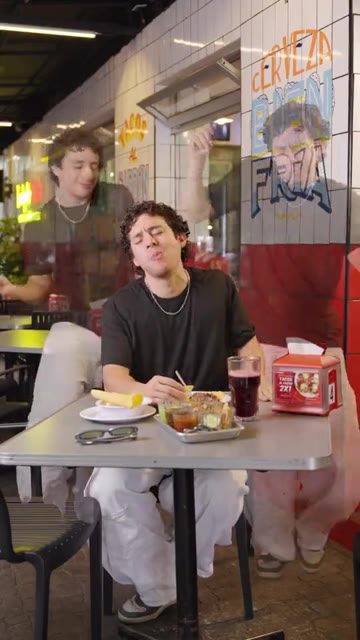
Teach Me How to Dougie AI is a Genjutsu AI photo-to-video template on genjutsuai.app. The reference clip is sitting at a restaurant table eating while see-through copies of the same person do the Dougie in the background, with the song. Your still changes who is on screen; the sample keeps the staging.
Anyone who wants that taco-table clone Dougie with their own face, or a friend’s face when that friend already agreed.
The sample holds sitting at a restaurant table eating while see-through copies of the same person do the Dougie in the background, with the song. A photo changes who is on screen; it should not rewrite the staging.
Background
Teach Me How to Dougie AI is a one-photo clone gag: you sit at a taco-restaurant table eating, while see-through copies of you do the Dougie behind the glass, usually to a “Teach Me How to Dougie” mashup.
Cali Swag District released the song in 2010, and the Dallas dance went wide from there. On 4 March 2025 @jeremy.dreyer posted a group Dougie that later sat around 10.4 million views. Clone-dance tutorials followed; by 4 November 2026 #clonedance held 1,918 TikTok videos and 46.9 million views, and #cloneeffect 5,257 videos and 76.9 million. The taco-table AI template is the one-photo version of that clone idea.
This page is an independent Genjutsu AI photo-to-video remake of that taco-table clone Dougie. Genjutsu AI is not affiliated with MakeViral, CapCut, or Higgsfield.
How it works
01
This page opens with the Teach Me How to Dougie AI clip already chosen. That file is the motion, the staging, and the timing.
02
A photo is optional. With no photo, the template still generates from the sample. Upload a clear face-on photo so both the eater and the dancing clones can keep that identity.
03
Press Generate. The button shows credits for this length and quality first. Keep source audio on by default unless you want a silent export.
Photo tips
The set, the timing, and the camera are already in the sample. The still only has to show the subject clearly.
Upload a clear face-on photo, large and sharp enough to read on both the eater and the dancing clones. Soft, tiny, or cropped-out subjects make identity drift.
Ordinary daylight or clean indoor light is enough. Soft focus, heavy beauty filters, and extreme HDR make identity drift.
The sample already has the taco-table clone Dougie staging. A photo with extra people or clutter makes the remap harder.
Use a photo of yourself, or of a friend who already agreed (or a child/pet you have permission for). Some templates ask you to skip children’s photos — follow that note when it appears.
Credits
The Generate button shows the credit price before you start. It follows the reference length and the quality you pick. A longer sample costs more, and 1080p costs more than 720p or 480p.
Sample length is the default. If a duration is missing, the studio measures the file, then shows credits. Your own reference video is priced from that file. Clips that are too long are rejected before a job starts.
Leave mute off for a soundtrack from the model, or check mute and add music later. Mute does not change the camera or the timing. A failed job returns the credits.
Use cases
The motion and the timing stay. The look changes.
Upload a clear face-on photo and leave the sample. You get a short clip of yourself eating while copies of you Dougie in the background.
One clip per subject who already said yes (or whose owner/guardian said yes). Separate photos keep each identity clean.
Run two photos through the same sample when you want to see which still holds the beat. Staging and timing stay fixed.
Generate with no photo to watch the motion, or to check credits and length. Add a photo on the next run.
Examples
The player at the top is the Teach Me How to Dougie AI motion reference: an eater at a taco table while see-through clones do the Dougie behind them. That timing is what Genjutsu AI keeps when a photo changes the look.
Other published templates use the same photo-to-video studio. Each one keeps its own sample motion, and you can open it to generate on that template’s page.
A Genjutsu AI photo-to-video template of sitting at a restaurant table eating while see-through copies of the same person do the Dougie in the background, with the song. Upload a photo to change who is on screen; keep the sample for motion and timing.
No. The clip generates from the template alone. Upload a photo when you want the look to change — with permission.
The aim is to keep the sample’s sitting at a restaurant table eating while see-through copies of the same person do the Dougie in the background, with the song. Extreme crops or busy group shots make remapping harder.
Look at the Generate button. The shipped sample is about ~12s. The price follows that length and the quality you pick.
Yes. Source audio stays on uploads by default for this template. Mute in the studio if you want a silent export.
A clear face-on photo, face large and sharp. Skip group shots, masks, and tiny distant faces. Use only photos of people who already agreed.